
Skim Coat Blade vs Skimming Blade vs Smoothing Blade: Same Tool, Different Names
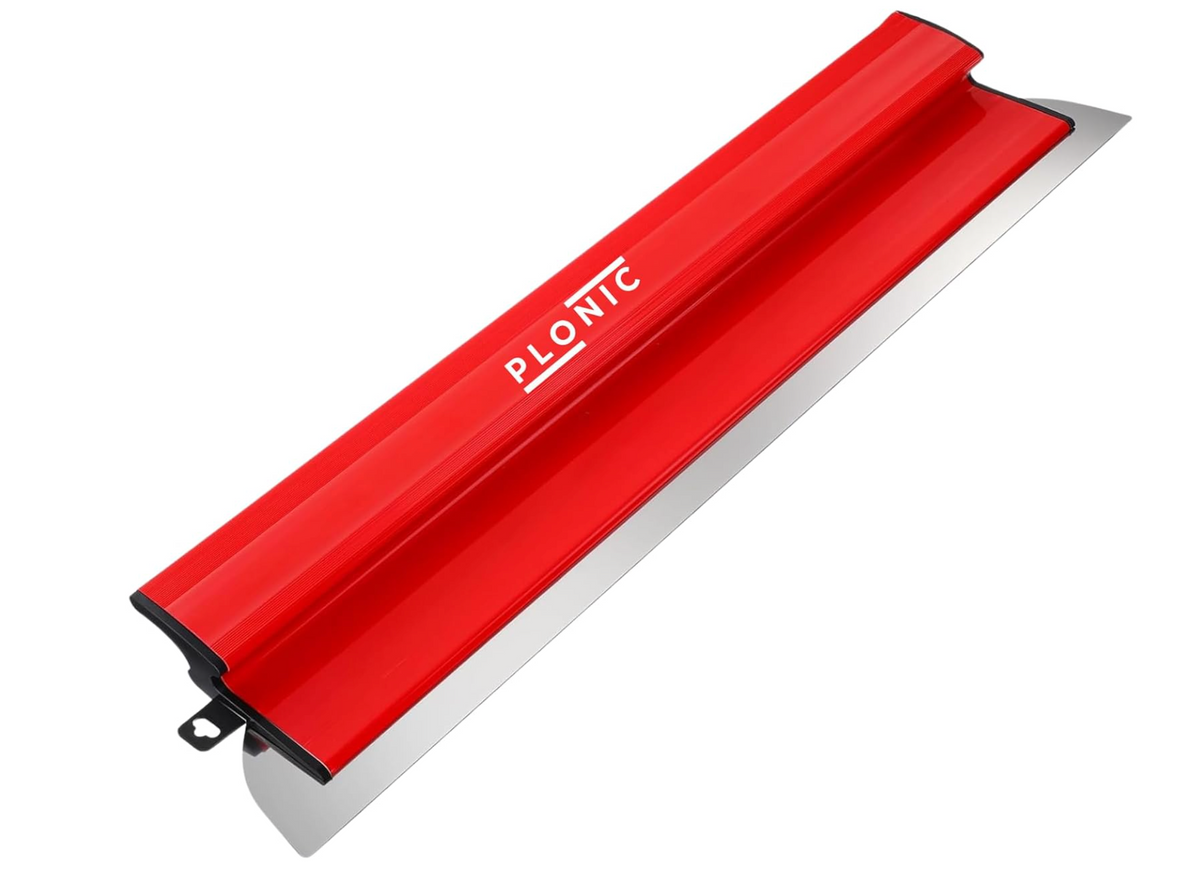
Skim coat blade. Skimming blade. Smoothing blade. Skimming knife. Drywall skimmer. Search any of them and you'll get the same category of tool — a wide, thin stainless steel blade in a rigid housing, pulled across joint compound to leave a flat, paint-ready surface. The names come from different trades and different countries; the tool is the same. Here's what each term means, why the names differ, and what actually matters when you're choosing one.
Five names, one tool
| Name | Who uses it | What they mean |
|---|---|---|
| Skimming blade | US drywall finishers, tool brands | The standard trade name. A 14"–48" stainless blade in an aluminum housing, usually with a pole mount. |
| Skim coat blade | Painters, remodelers, DIY | Named for the job (skim coating) rather than the tool. Same product. |
| Smoothing blade | Texture and sprayer crews | Used for knocking down and smoothing sprayed compound. Often a stiffer or all-aluminum version. |
| Skimming knife / spatula | UK, Australia, plasterers | Plastering-trade term for the same tool used on plasterboard and finishing plaster. |
| Drywall skimmer | Marketplace listings | Catch-all listing term. Check the specs — it covers everything from 0.3 mm imports to pro blades. |
What it is not
A skimming blade is not a taping knife and not a trowel, even though all three move mud.
- Taping knife (6"–14"): stiff, short, meant to bed tape and fill joints. Too narrow to skim a wall flat without ridges.
- Plaster trowel: rigid rectangular steel on a handle, used with a hawk. Great for plaster, but the rigid edge leaves trowel marks in joint compound.
- Skimming blade: wide and thin. The edge flexes just enough to feather itself, so a single pass leaves a flat surface that needs little or no sanding.
We've compared these properly in skimming blade vs drywall trowel.

The kit used in this guide
PLONIC 6-Piece Skimming Blade Kit
Six 0.5 mm stainless blades (6"–40") · telescopic pole · hard case · 6 spare inserts
★ 4.9 (36 reviews)
$129.99 · Free US shipping · 2-year warranty
Shop the 6-Piece Kit →What actually matters when you choose one
Blade thickness
This is the spec that decides whether the tool works. Most blades sold as "skim coat blades" online are 0.3 mm — thin enough to chatter, flex too far and leave lines. A 0.5 mm blade holds a consistent angle across the whole pull and still feathers its edges. PLONIC blades are precision-ground to 0.5 mm; if a listing won't tell you the thickness, that's your answer.
Steel
Stainless. Carbon ("blue") steel rusts the first week you leave mud on it. Look for a stainless insert that's replaceable, so the housing outlives the edge.
Width
Match the blade to the surface: 16" for patches and tape, 24" for everyday walls, 32" for open walls, 40" for ceilings and commercial flats. Our size guide covers this in detail.
Handle style
- Z-grip (flat) handle — the classic. Locks onto a pole for ceilings. PLONIC Stainless Blades use this.
- Round grip — a full-width round handle for long days on big walls, less wrist fatigue. PLONIC Professional line.
- One-piece aluminum — no insert, no screws, a stiffer edge for knockdown texture and rough first coats. The Round-Grip One-Piece 24".
How a skim coat blade is used
- Thin all-purpose compound to a thick-paint consistency (see exact ratios).
- Roll mud onto the wall with a 3/4" nap roller, or load the blade directly.
- Hold the blade at 10–15° and pull in long, overlapping strokes, light pressure, no stopping mid-wall.
- Let it dry, then a second pass at 90° to the first fills any low spots.
- Sand lightly (or not at all) and prime with a high-build Level 5 primer.
The full technique, including ceilings and textured walls, is in How to Use a Skimming Blade: Beginner to Pro.
Frequently asked questions
Is a skim coat blade the same as a skimming blade?
Yes. "Skim coat blade" describes the job; "skimming blade" is the trade name for the tool. Any PLONIC skimming blade is a skim coat blade.
What size skim coat blade should I start with?
24". It handles most walls, works on a pole, and pairs naturally with a 32" or 40" when you start doing ceilings.
Can a smoothing blade be used for skim coating?
If it's stainless and thin enough (0.5 mm), yes. All-aluminum smoothing blades are built for knocking down texture and are too stiff for a fine Level 5 finish.
Do skim coat blades work with any extension pole?
Most take a standard threaded pole through an adapter. PLONIC sets include a telescopic pole; single blades fit the same adapter.
Browse the full range of PLONIC skimming blades and sets — 0.5 mm stainless, replaceable inserts, 2-year warranty, ships in 1 business day.
Ready to skim? Get the complete kit
PLONIC 6-Piece Skimming Blade Kit
Six 0.5 mm stainless blades (6"–40") · telescopic pole · hard case · 6 spare inserts
★ 4.9 (36 reviews)
$129.99 · Free US shipping · 2-year warranty · 30-day returns
Shop the 6-Piece Kit →New here? Use code PLONIC10 for $10 off your first order. Just need one blade? See all sizes →